

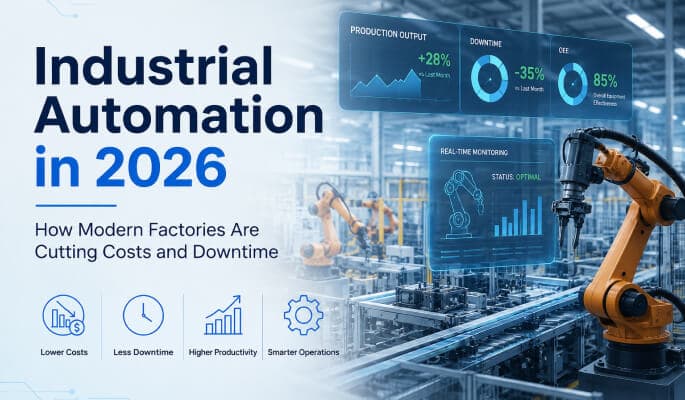
What Is Industrial Automation?
Industrial automation is the use of technology — software, sensors, and machines working together — to carry out tasks on the factory floor that used to depend entirely on a person doing them manually. That covers a lot of ground: a robotic arm on an assembly line is automation, but so is a system that automatically schedules production or flags a quality issue before it becomes a bigger problem. The common thread is that something that once needed a person to start, track, or finish it now happens on its own.
In short: industrial automation uses connected software and machines to carry out factory tasks that used to need manual effort — from physical processes like assembly, to digital ones like scheduling, tracking, and reporting.
Why It Matters More in 2026
A few things have changed that make this less optional than it used to be. Skilled labor is harder to find and keep in a lot of regions, and the people who do stay shouldn't be spending their day on repetitive manual checks. Customers expect faster turnaround than they did a few years ago, and a single missed delivery window can cost a relationship that took years to build. And the cost of getting it wrong — a missed delivery, a quality slip, an unplanned shutdown — shows up faster on a balance sheet than it ever has, because margins across most manufacturing sectors are tighter than they used to be.
Factories across India, UAE, and Africa are feeling all three of these pressures at once, which is part of why automation has moved from a nice-to-have to something leadership is actively pushing for. It's no longer just the largest plants making this shift either — mid-size manufacturers are finding that automating even one or two high-impact areas pays for itself well within a year.
Where Industrial Automation Cuts Costs
Less rework
Automated quality checks catch a defect at the point it happens, not three steps later when it's already cost more to fix.
Tighter inventory
Automated tracking means less money sitting in stock you don't actually need.
Fewer emergency purchases
When production planning is automated, you're less likely to get caught short and pay a premium to fix it fast.
Lower labor cost on repetitive tasks
Not by replacing your team, but by freeing them up for work that actually needs a person's judgment.
Fewer compliance headaches
Automated record-keeping means less time spent reconstructing what happened after the fact.
How Industrial Automation Reduces Downtime
Most unplanned downtime doesn't come out of nowhere. There's usually a warning sign — a vibration that's slightly off, a temperature that's crept up — and the problem is that nobody's watching closely enough, often enough, to catch it. That's exactly the gap automation closes. Sensors track these signals continuously, and the system flags a problem the moment it starts drifting, instead of waiting for a manual inspection that might be days away.
Manufacturers using connected, automated maintenance see unplanned downtime drop significantly, and equipment availability improve — the difference between a planned maintenance window and a line stopping cold in the middle of a shift.
30–50%
Lower Unplanned Downtime
For manufacturers running connected, automated maintenance.
25–35%
Higher Equipment Availability
More time producing, less time waiting on a surprise breakdown.
Manufacturing Software and Analytics: The Other Half of Automation
It's easy to picture industrial automation as robots and machines, but a lot of the real value today comes from manufacturing software working quietly in the background. Manufacturing analytics turns raw machine and process data into something a person can actually act on — a dashboard showing exactly where a bottleneck is forming, instead of a spreadsheet someone updates once a day after the problem has already cost an hour of output.
And right at the center of it is production planning. When a schedule updates itself based on what's actually happening on the floor — not what was planned a week ago — a lot of the cost and downtime problems above start to shrink on their own. A planner who used to spend the first hour of every shift just figuring out what changed overnight can instead see it the moment it happens, and adjust before it becomes a bigger delay.
This is also where manufacturing software earns its keep beyond the factory floor. Finance teams get more accurate costing data. Sales teams get a realistic delivery date instead of an optimistic guess. The benefit of good analytics isn't confined to operations — it changes how confidently the rest of the business can make commitments.
Getting Started Without Overhauling Everything
You don't need to automate the entire plant at once, and honestly, you shouldn't try. The factories that get the most out of this start with one area — usually maintenance or production scheduling, since that's where the cost of staying manual is highest — prove it works, and then expand. It's a much lower-risk path than a single, plant-wide rollout, and it builds trust with the team along the way, since people get to see the system work before it touches everything they do.
A realistic timeline helps too. Most automation projects that try to do everything at once stall out somewhere in the middle, because too many teams are adjusting to too much change simultaneously. A single workflow or module, rolled out in a matter of weeks with proper training, is far more likely to actually stick — and once it does, the next one is an easier conversation to have.
How Gemba Connect Helps Manufacturers Automate
Gemba Connect's manufacturing software brings the automation pieces above together into one connected platform:
Production Planning
Builds a schedule from live demand and capacity data, and adjusts automatically as conditions on the floor change.
Smart Maintenance Platform (MTS)
Turns sensor data into early warnings and automatic work orders, cutting downtime before it happens.
Quality Control Management
Automates inspection checkpoints so defects get caught at the source, not three steps down the line.
Production Costing
Gives real-time manufacturing analytics on where cost is actually going, order by order.
Real-time KPI dashboards
Bring every piece above into a single view, so the whole plant is working off the same numbers.
Frequently Asked Questions
Using connected software and machines to carry out factory tasks - physical and digital - that used to need manual effort.
It mostly removes repetitive manual steps, freeing people up for work that needs judgment, not full job replacement.
Sensors catch early warning signs and trigger a fix before a small issue turns into a breakdown.
No - starting with one area, like maintenance or scheduling, and expanding from there works better.
Manufacturing software is the digital layer - scheduling, analytics, dashboards - that often powers automation alongside physical machines and sensors.
Conclusion
Industrial automation isn't about replacing your team with machines. It's about giving your team better tools — software that plans, sensors that watch, dashboards that show what's actually happening — so fewer problems turn into costly surprises. Start with the one area costing you the most, and let the results build the case for the next.
Ready to cut costs and downtime with automation?